
Ellen Ross Health Report
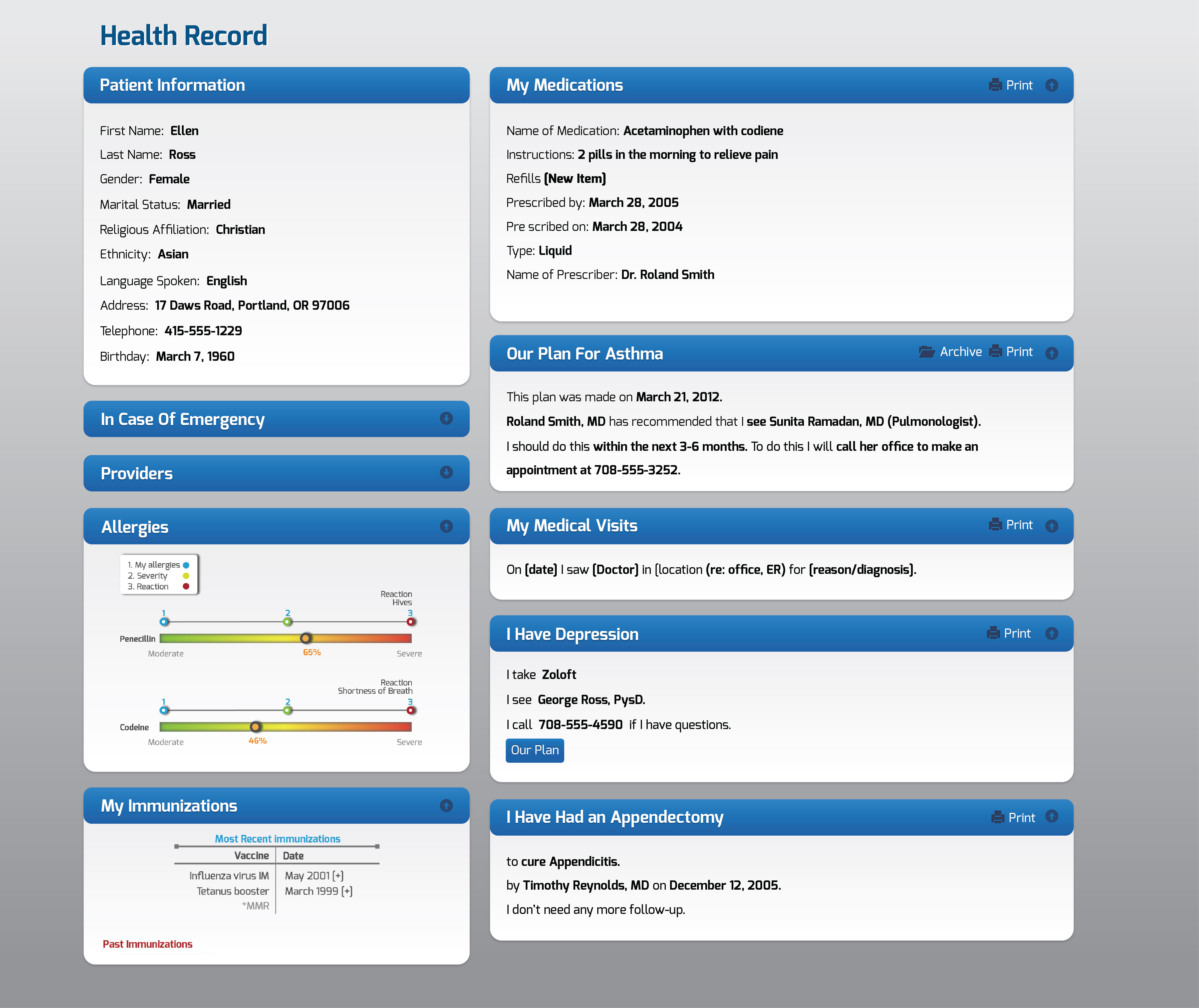
We created this design with the aspiration of making Patient-Provider communication easier. This was achieved by restructuring the visual hierarchy, by rethinking how the information is asked/presented, and by adding easy-to-understand graphics. This design was developed in Bootstrap to ensure optimal compatibility.
This design is organized so the patient’s pertinent information is in the left-hand column (patient information, guardian, allergies, and immunizations). We grouped this information together because it is information that tends to be static and has infrequent updates.
We dedicated the most real estate to the information that is the most dynamic and crucial to the patient’s health. We also reworked how many of these sections are communicated so that they were written in a way that provokes conversation and based on how a patient would explain it. Changing the form from the clinical language (i.e. Plan of Care or Encounters) to conversational “layman” language. Most of the sections can be collapsed (by clicking the small arrow on the right side of the blue box), this allows the Provider to minimize unneeded information. Each section can be printing individually.
Patient information: The content and organization of this section did not change. We decided that it’s clear and easy for the Provider to use. Guardian: We changed the title of this section to, “In Case of Emergency,” which is easier for the patient to understand. Provider: We removed duplicate information and made space for other providers/Specialists to be listed. Allergies: We made this information into an easy-to-understand graphic. The graphic allows the patient and Provider to quickly and easily review the allergy, severity, and reaction. Immunizations: We made this information into an easy-to-understand graphic table. The table allows the patient and Provider to quickly and easily review the immunization history by date. Medications: We changed the title of this section to, “My Medications.” We wanted organize this section by how the Patient thinks about their medications. Plan of Care: We changed the title of this section to, “Our plan for [condition/disease/disorder/ailment].” We wanted this section to serve as a conversation starter and agreement between the Provider and Patient. We envision that for each ailment a new “Our plan for [condition/disease/disorder/ailment]” would be created. Since plans change, an updated plan would be created and the older plans would stack behind it. When the plan is no longer needed for the ailment the plan can be archived. Encounters: We changed the title of this section to “My medical visits.” This title is more patient-friendly and explains the medical visit as the patient would explain it. The more encounters a patient has additional boxes will appear (note: these can be minimized). Problem list: We changed the title of this section to “I have [condition/problem].” This title is more patient-friendly and explains the problem in a way was designed to increase patient adherence. The “Our Plan” button at below the problem description is designed to connect the problem to the plan that the provider and patient created. The more problems a patient has additional boxes will appear (note: these can be minimized). Procedures: We changed the title of this section to “I have had [procedure].” This title is more patient-friendly and outlines the procedures that the patient has had. The more procedures a patient has additional boxes will appear (note: these can be minimized).
About the designers: Daniel Montesinos was born and raised in Barquisimeto, Venezuela and has lived in the United States for four years. He has a Bachelor's degree in Graphic Design and has worked for many years in the field. He is currently completing an Associate’s Degree in Web Development and hopes to continue on as a Web Master in the future. Lauren Becker has a Master’s degree in Health Communication from Emerson College in Boston, MA. She is interested in user experience design, communication analysis, and communication strategy in health. She is currently employed as a Health Communication Specialist at Dana-Farber Cancer Institute where she works with a team who develop communication materials that support researchers and/or research projects.
0 comments