
My Health, My Identity
Preface:
We chose paper as the medium for our chart, yet designed it in a way that would lend itself easily to a website. While we acknowledge that providing access to the medical record through a website is important, especially when considering younger generations, we chose paper for the sake of reach. Until everyone in this country has access to a computer, choosing a primary medium other than paper will exclude people (especially low-income families) from getting access to their medical information. Ideally, to appeal to the variety of audiences that need access to their medical record, this design would live in 3 formats: print, website, and mobile site.
The way we approached our design was patient-focused. While the design objectives for the contest called for a design that would enable patients and physicians to better understand and use patient health information, we believe that the specific needs of patients v. providers regarding this information are very different. In particular, excluding the highly motivated "Quantified Self" variety, patients need far less detail to effectively manage their health than providers. What we've done is to reorganize and give new meaning to the basic data from the CCD to help a patient better understand and manage his or her health.
We gave our "Joe Patient" chronic conditions so we could illustrate the patient record for someone who has to closely monitor his or her health.
Our Medical Record Breakdown:
Section 1: Overview (First page)
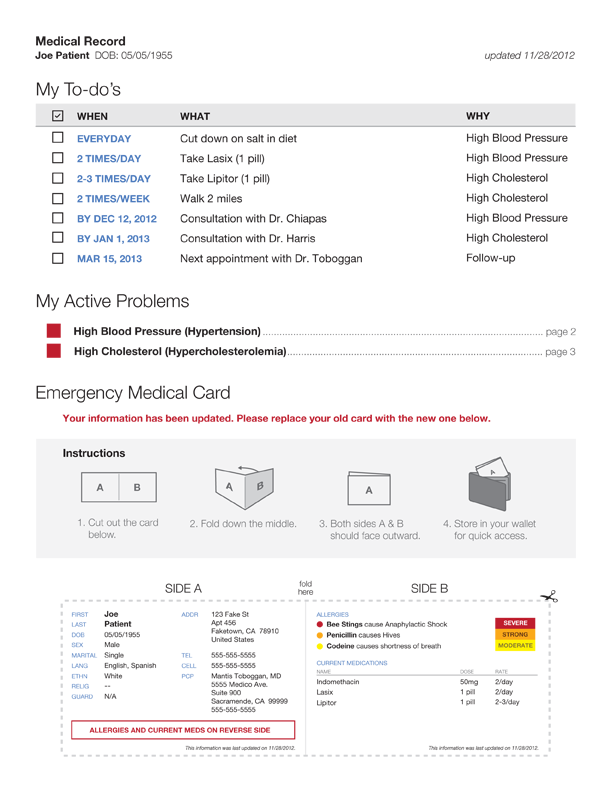
The overview (first page) is broken into 3 parts:
- My To-do's: A comprehensive to-do list that aggregates treatments, medication instructions, appointment reminders, etc. until the next scheduled appointment with the patient's PCP.
- My Active Problems: Lists the medical problems that the patient is currently being treated for. Simultaneously functions as a table of contents, listing the page number for the detailed explanation of the active problem (see Section 2: Problem List).
- Emergency Medical Card: Compiles patient demographics, allergies, and current medication information into a quick reference card for use in emergencies. When cut out and folded as indicated in the instructions, the card has the same dimensions as a credit card, and can be easily stored in a wallet (which is suggested).
Section 2: Problem List
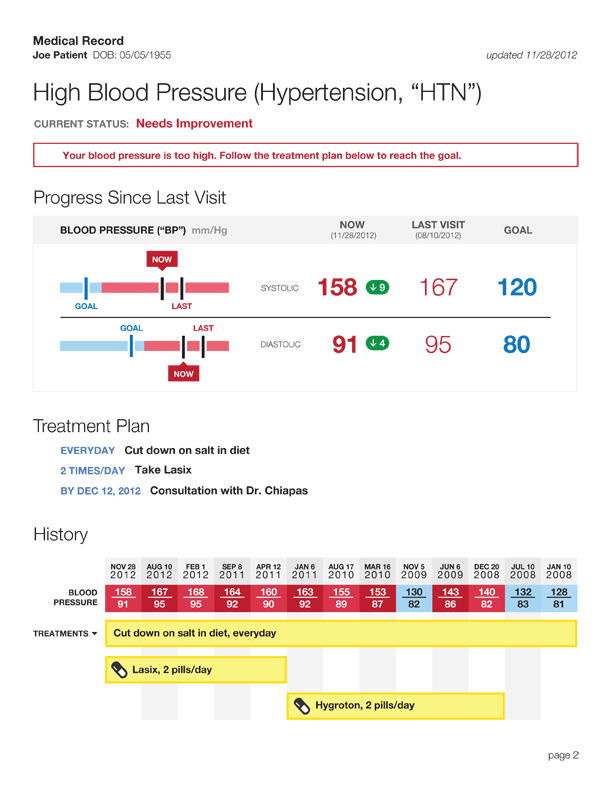
The motivation for this section is to provide patients, their providers, and their caregivers with a complete snapshot of each of the patient's problems, importantly separating the problem's current status and treatment plan with its past status and treatment history.
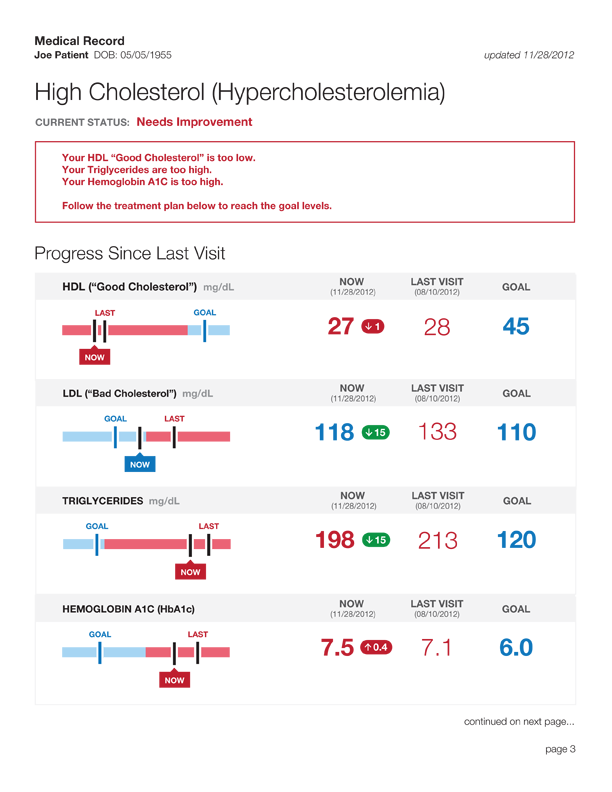
Each problem is divided into 4 parts:
- Current status: Lists the overall status of the patient's problem as well as the status of relevant vitals and lab results.
- Progress Since Last Visit: Lists the current, previous, and "goal" values for lab results and/or vitals relevant to the problem. The change from the previous to the current lab/vital result is also indicated next to the current number. Positive progress is indicated in green; negative progress in red (like stock quotes).
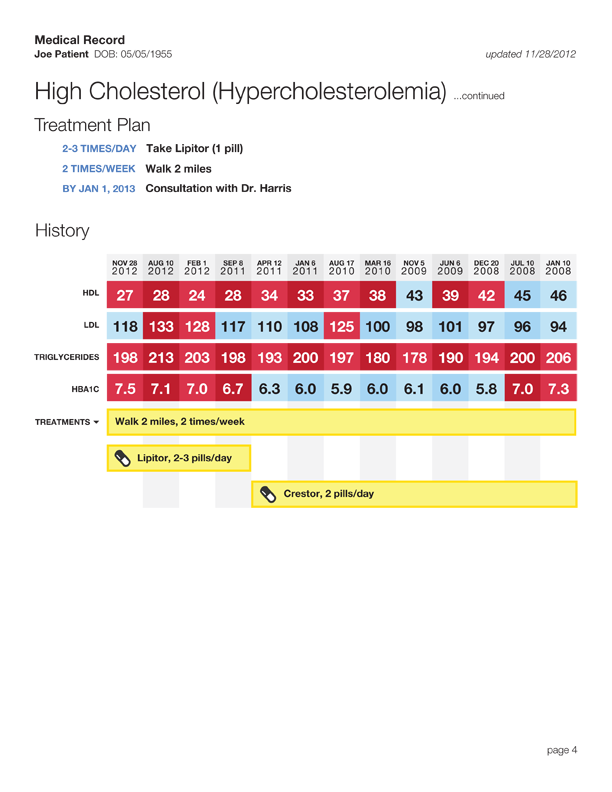
- Treatment Plan: Lists the current prescribed treatments for the problem.
- History: A longitudinal chart of lab results/vitals and treatments for the problem. Provides a helpful way to evaluate the efficacy of treatments - the doctor or patient can easily see the trend in lab values/vitals over the duration of a given treatment.
*If the patient also has problems that are controlled, they would appear in this section with the status: "Controlled".
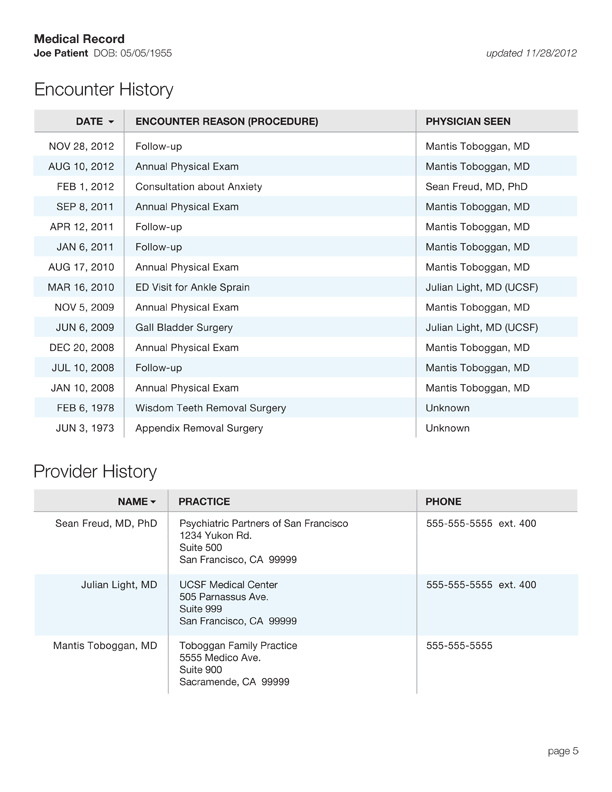
Section 3: Encounter & Provider History
All recorded patient encounters and their associated procedure(s) are listed chronologically. The Provider History section lists the providers referenced in the Encounter History with their practice and contact information.
0 comments